Sunday, 26 October 2008

My Secret Vice...

Neil Ayres, over at the Veggiebox which he shares with Aliya Whitely, has started a meme. It’s not one with loads of questions; in fact it has only one question – what’s your secret vice?

So far, people’s secret vices seem to be rather TV and film based. OK, I have that sort of vice too but it is AS NOTHING compared to my real vice.

Rucksacks.

Yes, rucksacks. Bags which you carry on your back, with shoulder straps. They’re everywhere now, from schoolchildren’s backs to pensioners’ garden-wandering shoulders and every kind of back in between. You can get teeny weeny little diamante encrusted numbers (except why would you?) and mammoth things which look as if they would literally hold the kitchen sink as you backpacked around the known universe. Everybody’s got one these days.

But I loved rucksacks well before all this ubiquity. I have loved them since I was thirteen and saved up my pocket money to buy my first one from my Mum’s catalogue – a grey canvas number with two outside pockets fastened with leather straps and buckles and leather shoulder straps. You pulled the thing closed with string strung through eyelet holes and buckled it up. Nobody had heard of snaplock buckles in those days. Nobody outside the American military had thought of ripstop nylon and waterproofed materials in the context of rucksacks. If you wanted things inside to stay dry, you put them in a plastic bag. Or a bin bag if you had a bigger rucksack, like the one I went around bits of Germany and Scandinavia with in my second summer at university. A huge blue karrimor beast with an external aluminium frame. I was also accompanied by my friend Jane, but she is not what this post is about.

Lots of people carry all their baby-changing paraphernalia in a rucksack now (from Mothercare, natch). I did it nineteen years ago in one from Milletts. It didn’t have a changing mat or a bottle pocket. Not that I had any time for either of those things anyway, but you get the point. If it can be carried in a rucksack, I will carry it in a rucksack.

My family is tolerant of my vice. If I don’t buy or otherwise acquire a rucksack in any given calendar year, I tend to develop a tendency to stand outside Millets, Blacks, Field and Trek or luggage shops with my little nose pressed against the window, muttering about compression straps, map pockets and attachment points. As we walk down the relevant street (in Canterbury all three outdoors shops are within 50 yards of each other – bliss or torture depending on my rucksack-affording status) one of the boys is apt to bark ‘step away from the rucksack shop, Mum!’ or take my by the arm and gently steer me away, depending on how manic the gleam in my eye is.
The Other Half is kinder, she lets me go in and stroke them.

So, for your delight and delectation, may I introduce a few of the current stars of my rucksack collection.

Cue music...


This is my current 'everyday' rucksack. Just big enough to get my little laptop into if I need to. I don't do handbags, this is as handbaggy as I get.
This one's a recent acqusition, replacing one I used for more than ten years ( I may be acquisitive, but I ain't fickle) until the main zip gave out a couple of months ago. I haven't been able to bring myself to throw out this old friend yet:

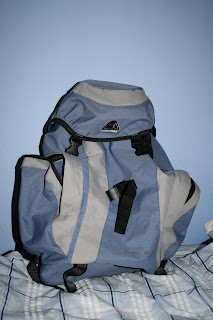
Then there's the walking rucksack for when the hiking fit is upon the Other Half and me...


...which also doubles as the 'I'm going shopping' rucksack for carrying loads of rice and stuff from the local wholefood shop.


The leather 'it's not a briefcase' rucksack:


...and the piece de resistance, the good old backpacking rucksack. This is the one I took when I went to the Reading Rock Festival last year with the Ultimate Frisbee Freak and the Bassist. It's still got the multicoloured straps i used to attach things to it...


I could go on, and on.....but as regular readers of this blog are probably already doing the cyber-equivalent of sidling away nervously and wondering whether to delete me from their favourites list, I shall desist.

I blame Neil... then again, perhaps I should have just talked about my dodgy addiction to the Archers...

Monday, 20 October 2008

Busman's holiday?

As I said in my last blog-post, I had intended that our time away in the Cevennes should be a complete break from the work in progress but things keep breaking in, and not entirely as a result of my inability to stop thinking about the book. So, as the weather is horrible today, I thought I’d tell you about one of the break-ins.

On the day after we arrived, there was a wedding in the village. As we’re across the valley from the church here, we wouldn’t have known anything about it but for the local custom which involves driving from church to reception-venue with one’s hand held permanently on the car’s horn. This produces an ever-increasing cacophony of horns at all kinds of pitch which, in the stillness of a remote French valley where every car engine is audible, is quite something.

So, why did this remind me of the work in progress, sitting on laptop and memory stick at home? Because this local custom is – I think - a remnant of the tradition of charivari whereby some marriages (and, more specifically, consummations) would be greeted by a noisy accompaniment from village people. Though this is known as a French custom, the sources I have read (for reasons which become obvious in a minute) suggest that it may, once upon a time, have been a far more widespread European folk-custom which sought to regulate and regularize marriage practices.

The reason I have been reading about folk customs is that a colourful one appears in my current book. The carrying of the ceffyl pren, or wooden horse, is likely (apparently) to be an offspring of the same ancestor as the charivari. Used, in the period in which my current book is set, as an tool of social disapproval, the ceffyl pren probably had its origins in a charivari-like ceremony which was then, by extension, invoked to punish those who were failing to be married in an acceptable way – wife beaters, adulterers and those who fathered and then rejected illegitimate children were all suitable candidates to be made to mount the wooden horse and be paraded and jeered at all around the village, with a little rough-handling from the men en route to make sure they mended their ways.

By the nineteenth century, its use had been extended far beyond marital misdemeanours and was used to punish anybody who was infringing generally-held social rules that were not otherwise safeguarded by the law. Cheaters, swindlers, sellers of substandard produce – anybody could find their door being knocked on in the middle of the night by a mob of their neighbours beating drums and blowing horns to create the maximum public kind of embarrassment as the miscreant rode around the village on an uncomfortably thin wooden horse.

The Rebecca Riots – rural unrest sparked off by the multiplication of illegal and overcharging tollgates on turnpike roads and the central theme of the work in progress – used the ceffyl pren and its associated carnival to great advantage. Men dressed as women, their faces blacked, rode out at night to right the wrongs being perpetrated in their community. And sometimes got a little out of hand...

From marriage 2008 via agricultural workers’ protests back into the mists of European folk history… as a novelist with a strong historical bent it seems I’ll never be safe from my source material; perhaps I should have brought the laptop after all…

Thursday, 16 October 2008

We're all going on an autumn holiday...

Having worked some time in lieu I have next week off from the day job as well as the following week (half term) so the Other Half and I are off to France to stay with her mother for a bit, leaving the Ultimate Frisbee Freak and the Bassist to fend for themselves for a week or so (with a freezer full of food…) They are under strict instructions not to let us come back to find that our feet stick to the floor and we can’t see any surfaces for unwashed crockery…

I was going to take my beloved laptop and put in a couple of hours’ work a day on the novel but, having thought about my current productivity (poor), I have decided to take a break. I have been working on the wip solidly for four and a half breakless months since the OH and I had a week’s walking in the Peak District, so I reckon I’m due a bit of a brain-holiday.

As I’m taking the only thing I bought with my recent royalty cheque – a new digital SLR camera – there will, hopefully, be some decent-ish pictures of the Cevennes in autumn to stick up here when we return.

Meanwhile, don’t do anything I wouldn’t.

PS, what about The White Tiger winning the Man Booker, eh?

Tuesday, 14 October 2008

I think JK Rowling is a narrative genius

Garrghh! The internet… Or rather internet service providers… Or, more specifically, BT telephone exchanges…
Thanks to one or more of these factors we won’t be getting a new ISP anytime soon, so all my hard work changing my email address and letting everybody know was a waste of time.
I say again, Garrghh…

I shall not vent my spleen a la Marcus Brigstocke on the Now Show (excruciatingly funny on the subject of his internet service provider’s shortcomings – can’t remember who they were but never mind, best not anyway [sorry to those who aren’t avid BBC Radio 4 listeners who will be baffled by these references.]
Instead, I shall pick up on a theme from a recent post on Tim Stretton’s blog. J K Rowling. What has the poor woman done to provoke such animus? (Not from Tim, I hasten to add..) Not to mention resentment and envy.
All it seems to me that she has done is write the most extraordinary series of children’s books since Susan Cooper’s The Dark Is Rising series.

A commenter on Tim’s blog is a prime example of the kind of thing often said about the Harry Potter books; not – one suspects – always by people who have actually read the books.

He is representative of the kind of thing Rowling is routinely criticised for.

Sample criticism 1: The Harry Potter books are a success because they are based on a clever idea, it’s just a shame JKR can’t write.

This implies that the person levelling the criticism thinks ‘writing’ is nothing more than prose style, the putting of one word after another into well crafted sentences; that inventing a unique setting, an internally consistent and believable world in which the great struggle between good and evil is satisfyinglyplayed outwith emotional realism is nothing more than cheap trickery which anybody could manage after breakfast and before lunch.
Hah!


Sample criticism 2: The books’ popularity is entirely down to the unfeasible attractiveness of Hogwarts and the japes which go on there.

OK, Hogwarts is a wonderfully seductive place – no bedtimes, wonderful meals, competition between houses, freedom from pretty much any rule outside the classroom, Dumbledore’s twinkly wisdom at the helm - what’s not to like? But I think this criticism completely ignores the fact that the Harry Potter books are actually far deeper than simple boarding-school-with-magic stories. They’re full of archetypes which, as any storyteller knows, is the best way to ensure that your books hook the readers in ways they don’t understand; and they’re about the eternal battle between good and evil. Neither archetypy nor the eternal verities are typical elements of most school stories. And, let’s face it, Hogwarts is not what has hooked hundreds of thousands of adults on the books, is it? [No, it’s not. At least not this adult.]

Sample criticism 3: JKR can’t write, has a dreadful prose style and so many other variations on a theme of ‘how can she have made this much money when we think our prose is far more deathless?’ that it makes me sick.

Style. Hmmm. OK, it’s not going to win the Pullitzer prize and the Man Booker judges haven’t troubled JK much. But let’s not forget something fundamental – these books are aimed primarily at children. Personally I think that’s something other YA writers of series have lost sight of in their rush for the 'crossover' market. I found at least one other highly successful 'children's' trilogy so bleak by the final volume that, had I read it as a child, I would have been deeply troubled.

Sample criticism 4: She just bolted lots of winning formulae together. To whit school story, magic story, cinderella story.

There are elements of all those things in the Harry Potter books but, for me at least, the narrative which makes up the series is far more than the sum of its parts. I don’t think JKR has just done a literary cut-and-shunt. I think she’s created a consistent and believable world. Magic is an excellent and ancient symbol for power and the witting misuse of magic is – in the Harry Potter books – always a misuse of power. The books are about power and its moral/ethical use to a far greater extent than they are actually about magic. That’s why they work for adults. If they were just about magic, they’d only work for small children who are OK with inconsistency and things happening improbably and without consequences.

Sample criticism 5: Her editors must be doing some of the writing because the books are a lot better now than they were at the beginning.

Are they?
Personally I don’t see the Harry Potter oeuvre fundamentally as a series of 7 books. I think they have to be seen as a continuous story, much like the Lord of the Rings (Nobody ever says, Oh, I really liked the Fellowship of the Ring but I didn’t go much for Two Towers or the Return of the King, do they?)
JK Rowling knew how the whole series was going to pan out from the very beginning and I think that shows. So I don’t see one book as better than another and I think those who think the later books are better than the earlier ones are just reflecting the fact that they have been progressively drawn in to Harry’s world. Those of us who found the world vivid and compelling from the beginning find locating our favourite HP book quite difficult.

The blog commenter on Tim’s blog also comes up with a less representative gripe as well:

To my mind the greatest sin Rowling commits is the clumsy and inappropriate juxtaposition of the cutesy and the deadly serious. It seems like she either couldn't make up her mind, or couldn't come up with a story that worked one way or the other.

That would be like Shakespeare in Hamlet, then. Gravediggers with laboured jokes… obviously the man didn’t know he was writing a tragedy.
Would we care about Harry if it wasn’t for the ‘cutsey’ elements with his friends and, presumably, the Weasley family in the Burrow? If the whole series was ‘deadly serious’ wouldn’t we be a bit tired and harrowed by the end of Philosopher’s Stone, never mind the rest of the series?
For me the juxtapositions of high and low drama are not clumsy but well-thought out, the ebb and flow of the heartbeat of life, pathos and bathos, tragedy and comedy.

I’ll come out and state my position with absolutely no embarassment at all – I think JK Rowling is a narrative genius.

Tuesday, 7 October 2008

My two hats

Generally, my day job – working with teenagers on the autism spectrum – doesn’t really intersect with my writing life at all, apart from the need to think very carefully about what you say before you say it. (Misunderstandings, as those of you in any way acquainted with an individual on the spectrum will know, arise easily and are not necessarily as easily cleared up...)

But then, along came Vicky Warren from The Bookfiend’s Kingdom. Vicky runs her site entirely in order to draw attention to the work of The Disabilities Trust which look after adults with autism, and to raise money for it. And, to do this, she talks to a lot of writers and works her way around the country tirelessly talking to novelists about their books, going to book fairs and generally being seen about at literary happenings.

She interviewed me in May and, a couple of days ago, I heard from her again, telling me that she had chosen Testament as her October book of the month.
How kind! Something tells me she really does like my book.

When she interviewed me, Vicky asked whether I’d be interested in writing something on what I do in the day job for her site. Given the state of the work in progress, I said I’d love to but would have to take a rain check. I’d still like to but the rain check’s still in my pocket (getting a bit limp) as the wip’s nowhere near finished as yet.

But, if and when I get around to writing my piece for the BFK on working with high functioning autistic teenagers in a grammar school setting (or whatever catchy title I manage to come up with, certainly not this one) it will be weird for both bits of my working life to be together under the same cyber-roof.

I’ve often thought of writing a book called something like ‘Ten Things every Parent of an Autistic Child should Know’.

If I did, would I publish as Alis Hawkins or would that just get horribly confusing?

Wednesday, 1 October 2008

That most delicate subject...

So, today is a very significant one in my life as a writer. No, we didn’t get signed up to a new internet service provider – haven’t even got our migration authorisation code yet and we can’t begin the move until that arrives, so we’re still on line here chez Bizarre – no, today I got my first proper royalty cheque, the one in March having only covered the period up til Christmas, ie before Testament was published.

And you know what? I feel rich.
OK, objectively I am far from rich. The amount I’ve earned is less than a third of the annual sum I gave up in cutting back on paid work but it’s still more money than I’ve ever earned in one go before. And it’s the only money I’ve ever made from writing, never having been one of those writers who enjoyed years of success in the short fiction market before moving seamlessly into novels.

And I noticed a strange thing in contemplating this royalty cheque - money earned from writing feels more worthwhile than other money.
Perhaps it’s something to do with the fact that, instead of being paid by some faceless bureaucracy which doesn’t actually have the smallest idea what I do on a day-to-day basis, the cheque sitting on my kitchen table is made up of myriad individual purchases by the reading public (even if some of them are prospective and German)
That’s why the money feels more worthwhile, because people have paid it over for this particular, specific, unique thing – my book.

So, on this very significant day in my writing life I would like to say thank you to all the people out there who have parted with their hard-earned cash to buy a hardback copy of Testament.

I am humbly and genuinely grateful.

Sunday, 28 September 2008

Art and Craft

Clearly, I have no thoughts of my own at the moment. This post, like the last, was sparked off by one of Emma Darwin’s on her excellent blog (if you haven’t read it, I recommend it, one of the best writers’ blogs around).
And, while I’m in confidential mode, posts may be even thinner on the ground than of late in the near future as my family is embarking on the hazardous enterprise of changing internet service provider… I know I need say no more. To paraphrase Captain Oates, I may be some time…
Anyway, on with the post.

What’s the difference between art and craft? And which is novel writing? Or is it possible to do it as either?

Personally, I’ve always felt that unless art has shedloads of craft behind it that it’s just a clever idea (like half a cow in formalin – not even necessarily a clever idea, just a novel one) and not art at all, but that’s just me. Think of the craft which went into the Mona Lisa, Canterbury Cathedral, Beethoven’s fifth symphony, Swan Lake.

Obviously, novels have to have craft – nobody produces in excess of 80 000 words that people want to publish and others want to read without demonstrating quite a lot of it – but where is the boundary between workmanlike, knowledgeable application of one’s craft and the extra something which makes a book into a work of art?

I always come back to furniture whenever I find myself having this kind of conversation with anybody.

Making decent furniture requires a lot of craft – you’ve got to know what the basic principles behind any sofa, chair, table or cupboard are. What are the accepted dimensions, how do you make joints which are going to stay joined, what is the best wood for a particular task, how do you finish surfaces….etc
And, if a person who has some natural feeling for making things with wood puts all that knowledge into operation in an intelligent and intuitive fashion, they will produce something which is functional, well built and pleasing to look at in the way that things which perfectly suit their purpose (think Shaker) are pleasing.

So, where does art come in?

OK, let’s narrow our field of vision and think about chairs.

Craft produces a chair that is wonderfully comfortable to sit in, a chair you sink into with a sigh and can remain in indefinitely without fidgetting, a chair which supports, envelops or displays you according to your taste.
But, bring art into the equation and your heart does a little leap every time you see the chair, it makes you think of beauty and timelessness and aspiration, it makes you glad on a level which isn’t just to do with comfortable sitting for weary limbs.

So what’s the analogy with novels?
Craft produces novels which people can immerse themselves in and enjoy for what they offer – plot, character, setting. The reader may forget themselves for a while and finish with a satisfied ‘yes, I enjoyed that’. But craft alone doesn’t produce a book which people will keep thinking about, which will make a reader stop at the end of a paragraph and think about what they’ve just read, which will cause people to re-read sentences, paragraphs – even the whole book, again and again because of the beauty of the words or the perfect encapsulation of the idea they contain.
Art produces books which make people see the world differently, if only for a while; which cause their readers to view their own life in a slightly different way.

So I ask the readers amongst you – do you have a different view of the difference between art and craft?

And as for the writers – do you see yourself as a craftsman/woman or an artist. Or are you both?

I’ll be back when our broadband’s migrated….

Monday, 22 September 2008

Voyeurism and The Mathematics of Love

Goodness, I feel so very dilatory at the moment as far as the blog’s concerned. Nearly every bit of creativity, effort and focus I possess is being poured into the work in progress and, if there are any scraps left, it goes into being a halfway decent person for my family to live with.

But something has made me want to post. A couple of days ago, Emma Darwin put up this intriguing post on her blog and it got me thinking, both about her book, The Mathematics of Love, and my own writing.

Having explained far more cogently than I have ever been able to (go on, read the post) why it’s easier to achieve the distance necessary to lift a story out of the morass of detail and on to a more abstract plane when dealing with historical narratives rather than with an all-too-familiar contemporary world, Emma goes on to say:

Fiction.. doesn't always want to be either abstract and eternal, or contemporary and particular: I don't think I'm unique in demanding of myself that it should be not either-or, but both-and.
I want to write particularities so that something - often I don't know quite what - emerges, is sensed and felt, which goes beyond the particular.

I admired and enjoyed The Mathematic of Love very much so, having read this post, I asked myself what she was using the particularities of the two narrative strands in her novel to say. What emerges from the particular circumstances of Napoleonic war veteran-turned landowner, Stephen Fairhurst and the naïve, worldly-wise 1970s teenager, Anna Ware?

Though it’s a little while since I read the book the word ‘voyeurism’ springs to mind. I was struck by how many times the word itself – or one of its grammatical relations – is used in the text and it is the concept of the voyeur that is the most definite ‘something’ that I felt behind the particularities of the text.

There is some blatant voyeurism (though I’m using the term somewhat loosely here to mean anything which gives the viewer a kind of illicit or societally shocking thrill rather than anything explicitly sexual) in that Stephen Fairhurst supports himself in the immediate aftermath of the war with France by doing battleground tours for parties of curious English tourists. These people have heard about the war from afar but now – now that it’s safe – they want to see the places that they’ve only heard about in the newspapers. Some want to see where loved ones died, others just want to see the place where unimaginable carnage took place, to get a safe echo of it.

But The Mathematics of Love also concerns itself with a kind of voyeurism which is nearer to the novel-writing bone and I found myself asking whether all artists (and, by extension, those who consume art) might be seen to a greater or lesser extent as voyeurs - as those who watch but don’t engage.

Lucy, a young woman frustrated by and intolerant of the social conventions of early nineteenth century gentility, is an artist; she hides behind her sketchbook and pencil, using them as a socially acceptable buffer between her and the censure of the world. Her art gives legitimacy to her need to look at things, however societally shocking, and to see them for what they are.
But, for whom is Lucy drawing? Whatever her stated reasons, whatever society’s complacent nod, it seems to me that she is drawing for herself, as a way of both seeing the world in a more objective way and of engaging with it in one of the few ways which is open to her.
So much, I suspect, is familiar to most novelists – isn’t that what we do – watch, interpret, produce something new as a way of communicating a vision of the world?

Is Lucy a voyeur – feeding on other people’s lives because she isn’t allowed to choose one of her own - or a clear-seer, someone for whom her sketchbook is not just a buffer but a lens?

In the twentieth century strand of TMOL, during the famously desiccated summer of 1976, fifeen year old Anna is also seeing things differently. During an enforced stay in what was once Stephen Fairhurst’s house and is now a struggling boarding school owned by her uncle, she becomes involved with photographers Theo and Eva. They introduce her to photography – both theirs and, as the novel progresses, her own – and, as Anna learns to look, to see, her excitement at watching things and people form before her in the red darkness of the developing room is the thrill of observing those who have been unaware of being watched. They come into view, coaxed by enlarger, developer and fixer and suddenly exist – the little strips of time represented by the negatives now a positive version of what the photographer has seen; her own take on the world and the people in it. And all seen from the anonymity which exists behind the lens.
The artist as watcher rather than participator.

But does the camera ever lie? More importantly, can a photograph ever tell more than a tiny part of the truth?
When Anna asks Theo what became of the Spanish woman he photographed during the Civil War, he is forced to tell her that he doesn’t know, that it was the moment that counted, he needed to capture that moment, the truth of it, the story of it.

But snapshots – though they tell a kind of story – can never give us the whole thing, can never tell us what came next.

Do novels, I wonder, do better or just differently?

Thursday, 11 September 2008

The Back Story

Long ago, says David Isaak, at least as time is measured in the blogosphere, I posted on the subject of unpublished works and the number of unpublished novels many well-known writers had piled up before they published their debut novel.

What, he asks his readers, do we have in our trunks, or our drawers? And, yes, he does acknowledge that unsold writing is ‘apparently always stored somewhere synonymous with points south of your navel.’

So, what’s in my nether regions?

Novel one – Making History – a non-murder crime story featuring a police officer protagonist and a historical element based in the Rebecca Riots (a theme I’ve returned to in the wip, see below). The agent who read it said that she wasn’t sure I was really a crime writer and that the book was more concerned with other things. I think that was very astute of her.

Novel Two – Hugo’s Words – a novel for teenagers about a boy (the eponymous Hugo) who has invented his own language and whose disaffected brother convinces a television celebrity that Hugo has – through some kind of spiritual contact – channeled a native American language lost to science in to the modern world.
Yes, I know…

Novel Three – Hearts and Minds – a homeless girl accuses a vicar of paying her for sex. The son of the psychiatrist who treats the vicar is, quite separately, drawn to spend time with a homeless youth, the best friend of the girl in question.
Much angst ensues. One of the publishers who read the novel (sent by an agent I had briefly persuaded to represent me) said that the psychiatrist (who I allowed to intrude into the action, erroneously as it turns out) emoted so much that if there was any more angst she would bite her own leg off, or words to that effect. She was right. Though I still think that the teenagers in the book were strong.

Novel Four – Testament. My MNW debut novel. Originally called Toby for reasons that will immediately be obvious to anybody who has read it.

Novel Five – the only novel I’ve ever abandoned unfinished. It’s also unnamed. Another children’s book, this time the beginning of a trilogy. Essentially a semi-supernatural quest novel but including a twins-separated-at-birth theme and a grandmother-granddaughter relationship which, I have realised (by reading my own writing) is a major preoccupation for me.

Novel Six – the work in progress. Details scattered here and there on the blog and on my website.

I’ve returned to the theme of book one in the work in progress in the sense that it concerns the Rebecca Riots in West Wales in the 1840s and an incoming entrepreneur in the present day who wants to set up a historical visitor attraction based on the riots. These two central ideas are the same, the rest of the book is totally different.

I’d quite like to return to the central premise of Hearts and Minds at some stage as I feel I’d do the idea more justice now, but we shall see.

As for Hugo’s Words. I really liked it but never attempted to get it published as everybody at the time told me that there was no market for teenage fiction.

Given the varied works outlined, it always feels weird referring to the wip as ‘my second novel’ and I sometimes qualify this with reference to the distinction between writing and publication.

Publication, unless you’re Faye L. Booth it's a long road.

Sunday, 7 September 2008

Publication and Perseverance

Recently, on the Macmillan New Writers’ collective blog, David Isaak asked ‘How does it feel’? How does it feel, x amount of time on from your baby’s release into the world, to be a published writer?

My response at the time was:

‘I think being published has changed the way other people see what I do rather more than the way I see it. I've always taken my writing very seriously but other people would look at my days spent writing while I worked part time at the money-generating job and think 'Isn't this a bit sad? Doesn't she realise that publication is monumentally unlikely?' Now they just ask, meekly, where they can get a copy of my book and when the next one's coming out. Prior to MNW saying they'd like to publish Testament, I always said I wouldn't stop trying to be published until I stopped developing as a writer. That hasn't changed either!’

But, in the weeks since I posted that reply, I’ve realised that there is something more fundamental that being published has done for my writing – it’s given me more confidence in what I do, in my own abilities and, possibly, my own potential.

Had I not had Testament published, I wonder whether I would have persevered with the work in progress. It’s not proving an easy book to write and, without the confidence of having been accepted into the MNW fold, without Testament going into paperback, I wonder whether I would have had the confidence to weather the difficulties which writing the current novel has thrown up and simply persevere.

Interestingly, it’s not just having had Testament published which has made the difference but one of the consequences of that publication – being a blogger and a reader of blogs. Without the posts of other writers which make it clear that not only is writing a first draft monumentally hard, it is also likely to yield only a ‘shitty first draft’ which must then be crafted via second and third drafts into something presentable, I might well have thought that I was alone in my frustrations.

So, another benefit of being published – it makes you believe in yourself, in your writing, despite struggles.

I just hope it’s not a misplaced belief.

Monday, 1 September 2008

Location, location, location

Shoulder on the mend, edit got back into after enforced layoff of holiday and agony, blogging recommences…

Sometimes, I wonder why any novelists set their books in real places. It involves a huge amount of extra research and the fictional evocation of any given town, city or country area is likely to annoy as many people familiar with it as it delights.

Obviously, those writing historical fiction concerning real people and events have no choice, they have to set their characters in their proper geographical context. But what about the rest of us? Does the portrayal of a specific place add an extra dimension to a novel that simply wouldn’t be there if its setting were fictional?

Apart from historical fiction, the genre which seems particularly keen on real locations is crime. Rankin’s Rebus, Brunetti’s Venice, Marcus Didius Falco’s Rome, Morse’s Oxford…Though I’m a crime fan, I’ll come clean and say that I’ve never read any of Colin Dexter’s Morse books though I have watched quite a number of the television adaptations. In the TV versions, the colleges and other locations are always fictional, though the game of ‘spot the college’, not to mention ‘spot the cut where the characters walk out of the main quad/library/lodge of one college into the garden/cloisters/hall of a totally different college’ is endemic amongst those who know Oxford well and accounts for at least half the fun of watching the programmes. But, on the page and away from the self-satisfied building spotting, would the Morse books be any less successful if they were set somewhere other than Oxford? Afer all, Ruth Rendell’s Inspector Wexford seems to troll around to his readers’ perfect satisfaction in the fictional town and environs of Kingsmarkham.

The question is, do people read novels – especially novel series – set in a recognisable location because the city is like another character, a known and loved one?
All I can say is that I don’t. Though the cities in all the crime series I’ve mentioned are splendidly realised, I would just as soon read about cities which came totally from the writers’ imagination.

And sometimes, your novel just demands that the place it’s set should have features and characteristics which mean that you have to invent, that no real place will quite fit what you’re trying to do.
That’s why Testament takes place in the fictitious city of Salster. It might have seemed that the more obvious setting would have been Oxford or Cambridge but so much happens in the book which – historically – couldn’t have happened in either of those cities because of their socio-political context that I had to set the novel in a place whose context I could manipulate and bend to my will.

Salster, though fictitious, is set in a very recognisably English context. I’ve invented a city, not a whole world. But what if the things you want to say in your fiction demand the creation not of a conveniently different city, but of a whole new world?

A book I recently read - Tim Stretton’s The Dog of the North - takes place in Mondia, a place not of our own world but which is recognisably northern european in terms of weather, custom and race. Similarly, its cities - Croad and Mettingloom - are sufficiently like medieval European cities to make the reader feel at home in them. In fact, the novel reads – as somebody more pithy than me has pointed out – like a historical novel based in a country you’ve never heard of.

But there’s more to the cities than just familiarity. In Mettingloom, Tim has created the most beautiful fictional city I’ve ever come across. It has the feel of a smaller, more intimate Stockholm, a frozen Venice, a city whose entire character changes between summer and winter, a change symbolised by the two palaces of Printempi and Hiverno with their own kings, courtiers and loyalties.
As a device for complicating a political situation, having two kings who each rule for half the year is wonderful but the winter and summer kings are also a fantastic metaphor for a city gripped in ice for half the year, warmed by the sun for the other half. People’s concerns about surviving the cold echo their difficulties in staying alive in the tricky political situation of a city divided. When characters obsess about being warm it’s both a mark of wealth and a metaphor for safety; keeping warm means not invoking the wrath of the Winter King and losing your comfortable appartments or the wealth with which you can clothe yourself in furs and provide yourself with the warmth of the mysterious dimonettoes.

I imagine it was the demands of plot which led Tim to set his book in an alternative world rather than the one we’re all more familiar with. It’s clear from his deft handling of political intrigue, his light touch with military strategy and single combat, his understanding of the way church and state lived symbiotically in the medieval period - not to mention his use of voice - that he would be a fine historical novelist if he so chose. But I’m glad that he chose to write under the fantasy banner – if he hadn’t, we would have been denied the creation of Mettingloom, a city which has the brittle beauty of a spun sugar swan, whose glassy surfaces mask the disturbing currents beneath and whose warming furs cannot quite keep out the chill of death.

Mettingloom has leapt over all other contenders to become my favourite city in fiction, somewhere I feel I’d recognise if I was transported there by some literary device and my blindfold taken off.

So how about everybody else? What are the other contenders for most memorable city in fiction, either real or imagined?

Saturday, 23 August 2008

holidays...

Well, the Bassist is celebrating his clean sweep of As at the Reading Festival and the Ultimate Frisbee Freak has gone to London for the Notting Hill Carnival so I should be getting down to work. But I've done something to my shoulder and sitting at the laptop isn't much fun, so I think it's going to have to wait a couple of days. V. frustrating. Still, nice to be back in the South East after the incessant rain and cloud we always seem to take with us to West Wales. Of which visit, more when muscles aren't complaining...

Thursday, 14 August 2008

Hooray

Well, it's clearly the Ultimate Frisbee Freak's summer. Three days back from playing in the world ultimate championships in Vancouver where his team (GB under 19s) got to the semi-finals, he has now made a clean sweep of A-grades in his four A levels. What a star! Takes his proud mother's mind of the wip that's for certain!

Next week, the Bassist's GCSE results...

Meanwhile we're away for a few days playing frisbee and seeing grandparents variously. I'll be back next week.

Tuesday, 12 August 2008

Notes and the first person plural

My notes for whatever I happen to be working on usually take the form of spider diagrams done in pencil (love the flow of a propelling pencil on paper...) in lined spiral bound A4 notebooks(difficult to get unlined, I would if I could, but don't want to pay lots) . These gobbets of thought generally discuss what happens, why and how in any given scene (or even conversation) but, occasionally, I have discussions with myself, in pencil, about where or how the scene should go. In these discussions, I address myself in the first person plural, as in 'do we think it's a good idea to...?, 'shall we get x to do y..?'

This has only recently struck me as odd, despite the fact that I know I've been doing it for two decades or so. Does anybody else address themselves this way, or am I alone in this particular kind of personal identity instability?

Friday, 8 August 2008

Hearing voices

Narrative voice. Authors are preoccupied by it but it seems hardly to be mentioned by critics/reviewers. Or maybe I’m just not reading the right reviews.
Reviews seem to concentrate on two, or maybe three things:
1. do the characters strike the reader as ‘real’ and their actions convincing given the personality which has been built up?
2. is the plot credible?
3. (depending on the type of book) is the pace of the book right?

OK, fair enough, if you can’t get those things right, why are you bothering? But why are we all struggling with narrative voice and structure if these things are never given a look-in at the critical table?

There are writers who have ‘a voice’ which doesn’t vary from book to book, one could hear their voice from any of their novels. Hemingway springs to mind, as does Austen, Dickens and Hardy.
But there are others of us – you can tell I’m indluding myself here as I’ve used the first person plural – whose voice depends on whose point of view we’re writing in. Which means that our ‘voice’ may feel different in each book or at different points in each individual book.

The trouble is, it’s possible to get a bit carried away with voice/s.

In the previous version of the work in progress, events were narrated by three different voices (three in the present day, anyway, there’s also - surprise surprise - a historical voice which has changed a lot less in the rewrite). A problem ensued - each character had so much of their own stuff going on (to ensure that 1 above was taken care of) that the central events of the book had a tendency to get lost in the noise (leaving 3 above very definitely not taken care of). The book was about too many things, too many people. It rambled.

Don’t get me wrong - I liked each of the characters, I’d spent a lot of time and effort in developing each of their individual voices and I’d become fond of them. It was hard to give them up. But the structure of the book suffered because of the extent to which each of the voices belonged to a fully-developed person with ideas of their own about what was happening and lives of their own which were going on against the backdrop of the central events. What didn’t work was the relative weight I’d allowed each character to give to their own lives in relation to the novel’s central events.

The current version of the story has only one viewpoint character in the present day and one in the nineteenth century. It’s a lot easier. And 1, 2 and 3 above are falling into line nicely.

Sunday, 3 August 2008

Things are looking better

It’s been a good week. When I decided that the work in progress needed to stop progressing and go into reverse in order to sort out characters and movement at the beginning of the action, I had racked up almost 106,000 words (353 pages). As of yesterday, I have re-written the first 44,000 words (155 pages) to my much greater satisfaction. So, despite the fact that I have enjoyed a minimal amount of the fantastic weather we’ve been having this week, I feel that the week has been well spent and the work is back on track. The character who had so concerned me has now assumed more of the space she should occupy in the book and events have fallen into a better rhythm around her. And, because relationships in the book are now better defined, other plotlines have assumed a greater degree of clarity as motivations come to the fore and I have been able to foreshadow things which (I know because I’ve already written them, now) come later in the book.

I’ve gone from knowing that something was wrong and almost being afraid to look in case more was wrong than I thought (don’t forget I’ve already put a previous version based on the same idea, which ran to 120 000 words, on a shelf somewhere with ‘OK but not good enough’ mentally stamped on to it) to facing up to the structural inadequacies of the narrative, setting about it, getting it right (or right enough for now) and now facing the rewriting of the middle section of the book with far more equanimity.
Which is a considerable relief.
Stephen King says you need to write a first draft to find out what your book is about. Not only is that true in my case but I’ve discovered that sometimes I need to write the first draft to find out how best to tell the story too. Emma Darwin’s current blog has this quote from a ‘how-to’ book: Shitty First Drafts: "All good writers write them. This is how they end up with good second drafts and terrific third drafts."

Here’s hoping!

Sunday, 27 July 2008

progress

I’m working very hard on the work in progress at the moment. So hard that I seem to have absolutely no mental energy left for the blog. Sorry. Things have, I know, been kinda dull here recently.

As those of you who have been following closely will know, I have stopped three quarters (if not more) of the way in to the current novel to go back and fix a character; and therefore fix the novel. It’s working, I’m happy with it, I’m approximately 25-30 percent of the way through the rewrite which I think is the most difficult bit. I’m much happier with what I’m producing now and I’m also happy that the book is about what I thought it was about, I just need to do it better.

When I stomp around the city on my daily walks, thinking about the book, things assume a very clear and defined shape. I see the themes, the layers, the interconnections in the narrative very clearly and this encourages me – I do know what I’m doing. But when I’m actually sitting there working on a scene, it’s difficult to maintain that ‘helicoptering’ over the book which keeps all the strands, metaphors, themes, recurrent images in mind. The whole thing becomes difficult to see and as a consequence, what appears in my mind when I’m away from the book is difficult, if not impossible, to achieve when I’m sitting there at the kitchen table working at it.

But… I know I’m closer to that vision this time around. When I’ve finished these rewrites and then when I’ve finished the whole draft, doubtless there will be more rewriting to be done. And so on until I’m completely happy with the result.

I rashly told Will, my editor at MNW that I’d have a draft to show him by September. Don’t think that’s going to happen. Because, even if a draft has been finished by sometime that month, it’s unlikely to be something I’d be happy to show him. Or anybody else.

Though it was an artificial deadline, set to give myself something to aim at, I feel bad that I’m not, realistically, going to make it. But the last thing I want to do is rush to get a version of the book done just so I can put it on Will’s desk when I said I would. It took me years to get Testament right and I need to remember that.

So, if blogging is sporadic over the next few weeks, please forgive me. Writing is in progress elsewhere.

Tuesday, 22 July 2008

The lush green work in progress

Our garden is not what it was. When we bought this house, five years ago, it had a ‘mature’ garden of unpruned shrubs blocking out the light from the back of the house and a monster privet hedge.
Over time, the Other Half - ably aided and abetted by my Dad (who says, and makes good on the saying ‘I’ll just rip it out, shall I?’) has removed all the shrubs, and chopped, hacked and, yes, ripped out the monster hedge. She has made a new border, altered the shape of the other borders (from straight to sinuously curving) and made a new sloping bed at the back. And now, following the demise of the last two shrubs a year or so ago, she has re-turfed a chunk of the garden. A small chunk, admittedly, but then it’s a small garden.
So we now have a beautiful patch of sink-your-toes-in green just outside the back door. For those of you in the horticultural know, we are aware that this is not the time to put turf down but, in our family, we decide when to do things on the basis not of the appropriateness of the season but of a) having the time b) having the money and c) having the inclination. Actually, c) trumps a) and b) pretty much every time. Inclination (otherwise known as being arsed) is all.
So, for two weeks we have (when I say ‘we’ I basically mean the Other Half who likes to commune with vegetation when she gets home from work on the basis that it tends not to answer back) watered and tended the new turves, hoping that they will ‘take’ and that the edges of each turf will not go brown and die, making the thing look like a shrunken, badly laid carpet.
Thanks to the assiduousness of the OH, it has taken. Hooray. And today when I was sitting on it having lunch (I’m allowed to sit on it, now it has ‘taken’) I was thinking how the process of writing a novel is a bit like this laying turf.

Stay with me here, people.

Each turf is a scene or a chapter and, if you’ve done your work properly and prepared the ground it will ‘take’ because you’ve done the preliminaries, got your subsoil right and put down a good matrix for the turf to lie on. In other words, your book’s structure is well thought-out and you write scene after scene, butting them up nicely against each other and hoping the joins between them don’t show. Or go brown and curl up. You want it to look nice and even at the end, not full of gaping cracks.
If your structure’s wrong, the scenes don’t lie properly, bits of them die because they’re in the wrong place, or you’ve not watered them (aka worked hard) enough.

The WIP, now I’m reworking the first 75% so that the last 25% will work properly has its share of brown curly edges. Some of the strips of turf are definitely in the wrong place and need to be cut up and laid in smaller fragments at the difficult-shaped edges of the garden. Some strips are totally dead and need to be pulled up (not hard because they’re not well bedded-in) and thrown away with a muttered ‘God…that so didn’t work!’ But – and here’s the bit which makes me want to curl up my toes in the lush green grass of it all – some strips are really beautiful. They are in the right place, they are bedded in well and they have nice green edges to match other strips up to. I am pleased with those bits. But they are only about half the story…

Fortunately (also fortunately for you, end of strained horticultural metaphor) the boys are away with their Dad all this week and are helping him move house next week, so, now that I’m on summer hols fron the day job, I have uninterrupted time to devote to the WIP.

Always supposing I can tear myself away from Wife in the North which, I have to tell you is considerably fab. But more about that anon.

Saturday, 19 July 2008

Nice surprises

Work ‘dos’ can be very tedious but ones at the Other Half’s workplace are generally hilarious and we went to one yesterday evening which was no exception. As well as the usual suspects, all of whom I know reasonably well as she’s been working there for nearly three years, there was a daughter-on-holiday who had been persuaded to brave the middle-aged lunatics and eat barbecued food and consume wine in the garden.
The Other Half and I shamelessly monopolised her all evening. As an ex advertising executive from London who is now a farmer’s wife (yes, farmer’s wife) somewhere in the vicinity of Hadrian’s Wall, even if she hadn’t been a delightful person (she was) her story of culture-shock would have been interesting. I also picked her brains mercilessly on the Ultimate Frisbee Freak’s behalf as the UFF has two career paths in mind – clinical psychology and advertising.

Poor girl, she must have thought she’d arrived in some kind of demented version of a careers evening. Still, she managed to look as if she thought I was a normal person and was, eventually, able to fend off brain-pickings by telling us about a friend of hers who is also a metropolitan transplant to the other end of the country. This person – Judith O’Reilly - has a blog which has now been turned into a book. I’ve been reading the blog today. It’s absolutely hilarious, particularly the bits about appearing on the Richard and Judy show. I now have to get the book. Off to Canterbury tomorrow to see if Waterstones have it. They’ve been coming up trumps recently – had a nice shiny copy of Tim’s Dog of the North on the shelves for me to buy, so I’m hoping that they won’t have missed a R and J book.
Also, in this post, Judith O’Reilly talks about a friend helping her to put together an advertising video clip. The friend, in case you hadn’t worked it out, was the young woman I was monopolising last night over sausages and chicken-on-a-stick.

Here’s said video clip. Also makes you want to read the book.

http://www.youtube.com/watch?v=l1guh4zx0O8&eurl=http://www.wifeinthenorth.com/


Who says partners’ work affairs are always a chore?

PS, can't seem to work out how to 'embed' the YouTube clip in the body of the blog - can anybody help me?

Friday, 18 July 2008

Testament goes Baltic


Just got an email from the Macmillan Rights Department telling me that Latvian publisher Diena are buying rights in Testament. So far Testament is being translated into German, Spanish and Latvian. Amazing!


I've never been to Latvia, or indeed any of the other Baltic states, though the Ultimate Frisbee Freak went there last year for an international Ultimate tournament. My book (not to mention my offspring) is fast becoming better travelled than I am.

Thursday, 17 July 2008

Getting There

When you start revising bits of your book, one thing leads to another. Bringing in one of my characters earlier in the action seemed like a relelatively simple manoeuvre but, once I’d started, all sorts of other things became necessary so that she could appear sooner. And those necessary things are having a dramatic impact on the book – for the good, I hasten to add. Its original sprawl over the first hundred pages (me writing my way into the book) is being tightened and focused, the cut and paste functions of MS Word, not to mention the option of being able to view two documents side by side onscreen, have never been so busy on my laptop. And I’m getting there. I’m a much happier writer this week than I was last. Events are more clearly defined, as are motivations, characters are getting sharper. I’m pleased.

During a particularly doldrummy period over the weekend I read an interview with John Mortimer in which he said something to the effect that he’s only happy when his writing’s going well and if it’s not going well he’s in despair. Well I know exactly what he means. It just messes up my whole life if the writing’s going badly. there was a phase when it felt I was never going to get this book right and, as this is the second major re-write, that felt like a big deal.

Does anybody know which famous author it was who said that what they liked about writing was the sensation of just having finished a book? That they didn’t particularly like the process of writing? I know I’ve read it somewhere but I can’t remember who said it, though I have in mind it was a woman writer. Probably means it was Hemingway knowing the accuracy of my memory. But that’s what I’ve felt like recently – the pleasure in writing had begun to fade and I was beginning to just look forward to having finished. Now the pleasure in the process is back, thank goodness!

By the way, in case any of you aren’t regular readers of Tomorrowville, do go over and read David’s latest post on point of view. It’s fascinating and may spark an answering reflection here in a couple of days when the cut ‘n’ past is assuming manageable proportions…

Monday, 14 July 2008

Making Novels

The Other Half and I both love Terry Pratchett. Our house has at least one copy of every adult book he’s ever written and most of the ones for children too.
We’ve always got a TP on the go which we read aloud to each other and, at the moment it’s Making Money, Pratchett’s take on the banking industry.

Last night I came across this paragraph:

The bit of Moist’s [the central character is called Moist von Lipwig – don’t ask me why but it is significantly horrible to read aloud – conjures horrible images] brain that was trying to keep up with his mouth thought: I wish I could make notes about this, I’m not sure I can remember it all. But the conversations of the last day were banging together in his memory and making a kind of music. He wasn’t sure he had all the notes yet, but there were bits he could hum. He just had to listen to himself for long enough to find out what he was talking about.

Is it me just seeing novel-writing detritus everywhere at the moment, or is this TP talking about the process of digging a novel out of the subconscious?

Thursday, 10 July 2008

Funny old weather

For some weird reason the horrible weather is proving far more conducive to producing decent prose than the lovely weather we were enjoying last week. Suddenly, despite giving in and starting on a few ‘fixes’ in the wip, things are looking better. Actually, I’ll be honest and say that once I got back to the fixes I realised that the holes/difficulties weren’t as horrendous as I’d allowed them to become in my imagination. And I had a look at the first chapter again yesterday. Prior to that I’d decided that three pages of dialogue was no way to start a book. Now, I’m not so sure…
Maybe rainy old Britain is a good place to write from after all.

Monday, 7 July 2008

Getting things in focus

I’ve always thought writing novels must be a lot like acting. You’ve just got to get inside the character’s head to be able to portray his or her every move, word and action convincingly. You’ve got to stop being you and be the other person while you’re writing him or her. Even if all characters ultimately have their roots somewhere in your own subconscious, you have to stop being the everyday you and take on the mantle of somebody you have never been and, if they’re the other gender, could never be.

The problem with a novel is that you’ve got to do this for multiple people rather than just for one. And, while I can happily reside in the heads of a couple of people – the two main protagonists of my novel – trying the ‘method’ on three or four is a far tougher proposition.

There is a character in the wip who has been given insufficient of my time. Or I think she has. On the other hand, it may be that she has been hiding herself, waiting to reveal all in one climactic scene. Clearly, though I say ‘she has been hiding’ I mean ‘my subconscious has been hiding her’, my subconscious knowing better than my conscious brain that she should not be in front of the camera, as it were, the whole time. She should be keeping her mystery.

But the question is – is she mysterious or just underdeveloped? I need to read what I’ve written as a whole to really know, and I don’t want to do that at the moment as I need to keep up the momentum to the end of the book. Or it think I do.

I know that the received wisdom is that you just carry on, plough through until you’ve reached the end of the action and then go back and fix the details in the rewrite – what an electrician would refer to as a second fix. But this is my fifth book and that’s never really worked for me. I’ve always been the kind of writer who needs to be pretty happy with things as they’re unfolding, rather than thinking ‘doesn’t matter, fix it on second draft’ because one of the problems - if you’re writing essentially character-driven stuff rather than plot driven - if you haven’t got the characters right, then the story’s not going to work.

All of this may simply be rubbish of course. I may just be feeling wobbly because my whole writing rhythm is off at the moment now that the boys are done with school for the summer and are at home when I’m used to having an empty house to write in; an empty house which I can pace around looking for my characters, wondering what makes them do things and what will happen as a consequence. Wandering around a house full of young men (the UFF, the B and their friends) trying to listen to my characters inside my head is a little like trying to watch one of those overhead TV’s in a service station – you catch the odd thing but mostly you can’t hear what’s going on and the actions you see onscreen are meaningless without the words and background.

If only the garden were big enough for a shed…

Wednesday, 2 July 2008

Not in the zone

Sport has ruined my writing today. No, not Wimbledon, though I really would like to watch the Murray match later – his comeback on Monday night was the most astonishing thing I’ve ever seen at Wimbledon. No, ultimate frisbee has thrown my writing to the winds today. The Bassist is off to play for the Under 19 Great Britain B-team in the European championships in Slovakia and he was packing this morning.

I was at the dining room table attempting to push forward the literary fronteirs while fending off…
‘Have we got…
‘Do you know where…
‘Are there any clean…
‘I think it might be at Dad’s but…
‘Do you remember that…
And, sometimes, as we all know, it’s just easier to go and find whatever it is than to explain where to find it. Especially to someone who is 16 and has a Y-chromosome.

To be fair to the Bassist, he has only just got back from a week’s work experience at a design company in London where he had a great time, so it feels as if he’s a very busy boy at the minute.

What with that and the Ultimate Frisbee Freak dashing off to Birmingham, Manchester and other places north of the Watford Gap to attend GB training camps in preparation for the UF World Championships in Vancouver at the end of July, it feels like ultimate frisbee is dominating our lives even more than usual at the moment.

So here I am, having seen the Bassist off on a train to London, trying to gather my scattered wits and finish the scene I started yesterday. But wits seem to be all over the place and if rain hadn’t stopped play I’d be watching Roger Federer mince Mario Ancic by now because one thing I've learned in writing is that if it persists in not going well for more than an hour or so, it's time to do something else. My brain needs downtime when it’s scrambled and trying to cudgel it into co-operating a) doesn’t seem to work and b) makes me depressed at my failure to be able to do it.
And it was all going so well yesterday.

Later…
OK, it’s now an hour later and Federer and Ancic are back on centre court. Federer has clearly got my problem – something (in his case having a 2 hour rain break) has totally thrown him out of his rhythm and, after winning the first set 6-1 he just can't seem to get back into his groove. Boris Becker has just remarked that tennis is ‘a mental game’ and whilst it sounds silly, I know what he means – with no team-mates to buoy you up you’ve just got to keep yourself in the zone, believing in yourself, seeing the game going your way inside your head.

Well, writing is the mental game par excellence. Definitely no team mates unless you’re Aliya Whiteley and Neil Ayres or Sean French and Nicky Gerrard. You just have to keep yourself on top of your game and interruptions, particularly if they are long or persistent are ruinous to the trick of being able to stay in your fictional world. And there’s no way you can write convincingly unless you’re there. If you’re on the outside looking in all you’ll ever write is pedestrian reportage.

Ancic has just gone 4-3 ahead in the second set. At this rate I’m not going to see any of the Murray match - book group tonight where we'll be discussing Engleby. I'm confidently predicting an argument as I'm pretty sure at least one of our number will have deeply hated the central character and therefore the book.

Oh well, I shall be earning a crust tomorrow at the day job and then back to work on the wip on Friday. If it goes well until late in the afternoon, maybe I’ll reward myself with a little look at a semi-final.
Then again, maybe not.

Saturday, 28 June 2008

Good and Bad things happening in the w-i-p

Something very gratifying ocurred this week in the work in progress. I’ve known since the beginning of the book that a certain thing happened between two of the main characters but what I didn’t know was why. Now I do. It just emerged one day from thinking about the characters and what was happening to them at the time. It was a relief as I’m heading inexorably towards the scene where this event happens and I was beginning to worry that it wasn’t going to happen at all as the motivation wasn’t there. But now it is and I’m left thinking, ‘of course that’s why it happened, how could it be otherwise?’

I find this whole process – that of knowing that things must happen but having to find out through familiarity with the characters exactly why they happen – to be simultaneously baffling and fascinating. And, in its fascination, it’s one of the things I love most about writing, the fact that these characters have become so real to me that watching them interact explains the reasons behind events I imagined before I knew them.

Another gratifying thing was that I wrote a scene I was very pleased with. It was something a little out of the ordinary and I knew it was going to be a difficult thing to get right but, after a couple of days I found I’d achieved what I set out to do in terms of action, voice and emotional interplay.
And then the bad thing happened. The following day, when I came to review the scene and move on to the next, I realised that it didn’t fit.
As a rule, I tend to write chronologically, writing scenes in the order in which they’ll be read rather than employing a cut-and-paste technique where scenes get written as they occur to me and are then slotted in when their moment appears to have arrived. And this just wasn’t the next scene. I had thought it was for various reasons but, once I’d written it, I realised that it had the effect of brining things in one narrative thread to a head much too soon. But all is not lost – the scene still has a place in the book, it’s just much later on. Because it will now be out of the immediate narrative flow, putting it in later will inevitably entail some re-writing as things will have moved on in various directions but, nevertheless, I think the bulk of it will be useable.

Thankfully, I don’t tend to write scenes in the wrong place too often. What I do have a tendency to do is to write scenes which don’t actually belong in the book. I write them and I read them the next day and I think ‘this is OK but it doesn’t need to be in the book. It’s too long, the same effect can be achieved by putting in a few lines somewhere else. Then again, sometimes I think I’m going to sit down to write one kind of scene but a chance remark by one of the characters (this happens a lot in dialogue scenes which is why there’s quite a lot of dialogue in my books – I need to hear my characters interacting) takes it in quite another – usually much better – direction.

All of which makes it sound as if my method of constructing a book is chaotic verging on anarchic. Not so. I go for weeks just putting scene after scene after scene, like a brickie putting one course on top of another to make a wall, then a room, then a house. I reckon I’m halfway up the first floor (second if you’re in the US) at the moment and the roof’s in sight. Windows and the rest of the ‘making the house watertight’ I consider to be final draught stuff. We’re not quite there yet but I know what sort of windows I need and I’m pretty sure they’re available.

Oh, and the other thing I’m happy about this week is the way I haven’t allowed Wimbledon to get in the way of work. I watched my first match today – Murray v. Haas. It was a good one to have saved up.
(For those of you who didn’t see it/aren’t interested, Andy Murray, the young Scot, won in four sets. Except… why am I telling you if you’re not interested?)

Tuesday, 24 June 2008

Listening to me rabbit on

Back at the end of May I did an interview with the delightful Vicky Warren from the Bookfiend’s Kingdom, a literary website set up to raise money and awareness for the Disabilities Trust which cares for adults with an Autism Spectrum Disorder. It’s a fascinating site with interviews (some written, some spoken) with people as varied as Danny Scheinmann (Random Acts of Heroic Love), Charley Boorman (Long Way Round and Long Way Down with Ewan McGregor) and MNW’s own Len Tyler. And now me.

When Vicky initially got in touch, I assumed that she knew that I worked with teenagers with autism and had decided to interview me because of that. But no. She just liked the look of Testament and had decided to interview me. So she came, chauffeured by her friend Debbie and, having propped up her little recording device on our kitchen table, we did an interview. Amazingly, I sound quite coherent.

If you’re remotely interested in hearing me rabbit about Testament for many minutes, or even in just hearing what I sound like, (not what I think I sound like, incidentally, but that’s universal) click here.

If not, have a look at the BFK site anyway, Vicky has interviewed numerous authors so you’re bound to find somebody you’re interested in!

Sunday, 22 June 2008

A Tag...

I’ve been tagged by Akasha Savage over at Aspirations from the Darkside. Quite a restful post to put together on a Sunday evening…

What was I doing 10 years ago?
Working as assistant to the fundraiser at a local charity for homeless people. Writing a novel about a homeless girl who accuses a vicar of paying her for sex. Meeting my sons – then aged eight and six - from school every day and playing a lot of football with them. Those were the days when I could actually keep up with them when playing sport…. sigh….

Five things on my 'to-do' list for today.
When I worked for the NHS, I was obliged to keep a ‘to do’ list which my manager was entitled to see at any given moment. Suffice it to say that I have never kept such a list since.
I do, however have a Don’t Forget whiteboard in my kitchen which has things on it like ‘Ben birthday’ ‘ring C’ ‘car Friday’ and so forth. This is just to remind me of the things which I cannot afford to forget without a) losing money b) losing friends c) losing my mind.

What I would do if I were a billionaire.
Give all but a million of it away. I feel that I could use a million constructively without ruining my life or anybody else’s. And I wouldn’t have any of that ‘set up a charitable trust’ thing. Too much decision-making and letters and stuff. Just make some decisions, give it away. In big chunks so it might actually do some good.

Three bad habits I've got.
Taking my glasses off and either forgetting where I’ve left them or sitting/standing on them.
Answering the phone when I’m writing instead of doing what I’m always saying I do and letting it ring. It’ll only be people trying to sell me stuff as all the family know to ring me on the mobile if there’s anything I need to know during the day.
Reading into the early hours of the morning instead of going to sleep and getting a proper seven or eight hours. Tsk...

Snacks I enjoy.
Snacks? What are they?

The last five books I've read.
The Other Side of the Bridge – Mary Lawson. Wonderful, wonderful, wonderful. Should have blogged about it but didn’t. Probably too busy writing.
A Short History of Tractors in Ukrainian – Marina Lewycka. Good, amusing, poignant, learned stuff about Ukraine. And tractors.
Engleby – Sebastian Faulks. See last post.
Going Postal – Terry Pratchett. I love Terry Pratchett. His biog says he is ‘occasionally accused of literature.’ I am one of the accusers.
Brain Rules – John J. Medina. Non-fiction. Twelve things from neuroscientist John Medina that you need to know about how your brain works. Exceptionally accessible and amusing.

Five jobs I've had.
Cooking at a café attached to a working water mill (and therefore tourist attraction) near my childhood home in West Wales. This was during the summer before I went to university. I worked with a lovely girl whom I knew vaguely from my village (she’d been at boarding school) who taught me how to cook ‘make it up as you go along’ soup, was unfailingly lovely to the punters and very nice to me. Her name was Pat Llewelyn and she went on to discover Jamie Oliver and the Two Fat Ladies (for those in the US, both JO and the TFLs are celebrity TV chefs). She’s one of my few claims to fame.

Serving burgers in Burger King for a year between Oxford and training as a speech and languagae therapist. This was a necessary corrective to three years at Oxford.

Speech and Language therapist for various NHS trusts. I discovered that a) I was atrocious at filing b) I dislike working for big organisations c) I dislike the words ‘the Trust’s policy on this is’ and ‘the guidelines specify...’ Phrases of this kind make me want to swear and throw crockery.

Assistant to charity fundraiser (mentioned above). This was unpaid but one of the most enjoyable jobs I have ever had. I learned loads of stuff including that requests beginning ‘It would be really great if..’ worked much better on me than instructions beginning ‘You can’t/must/should…’

Independent SLT specialising in autism spectrum disorders. My current day job. This is v. cool mainly due to having a boss who has about as much regard for ‘the rules’ as I have.

These are pretty much all the jobs I’ve had, ever, apart from the long term ones of a) mother b) writer. None of the others has been remotely as interesting as a) or b)

Five places I've lived.
On a dairy farm in CwmCou – a little village in Ceregion, West Wales. This is where I grew up. Idyllic is the word.

In Oxford (as a student) first of all in a 60s block where, for the first time in my life, I could lie full-length in a bath (they were built for rowers when the college was men-only, I’m five foot ten); then in a little terraced house down the Abingdon Road where none of us did housework and I discovered (from a housemate who was a chef) how you test when spaghetti is done; finally in a first floor room on the main quad of my college. College founded 1516, date of room unknown but probably thereabouts. Friends could stand in the quad and shout 'Alis are you in?' V. Oxford.

Inside my head… This is where all writers live, really.

That’s it folks! If you’d like to do this one, consider yourself tagged and go to it…

Tuesday, 17 June 2008

Engleby


I’ve just read Engleby by Sebastian Faulks. It is in many ways an amazing book. The phrase tour de force springs to mind and when you see that the OED defines this phrase as meaning ‘a performance or achievement accomplished with great skill’ you see how apt it is.

It takes great skill to write a case study in personality disorder and make a gripping novel out of it. It takes great skill to tell you everything and nothing at the same time. It takes great skill to revisit episodes several times, from perspectives different or the same, and tell your readers more each time without making them feel that they have been short-changed first time around.

It takes great skill to engage a reader with a central character who is pathologically egocentric, who describes a life of unutterable desperation and who cogitates frequently on the meaning of life, time and death without appearing pretentious or up yourself.

Michael Engleby (alias Toilet, Groucho, Irish Mike, Mike(!), Michelle Watt, Michele Watts and latterly Michael Watson) is not a nice person. Even he doesn’t like himself. But then, he doesn’t really like anybody. He thinks he likes Jennifer Arkland, but in fact he is merely obsessed with her, or with the idea of her. And he clings to this ‘idea’ of her despite all evidence which would alter it, including her own words in her diary. He idolises her, or perhaps fetishises would be a better word.

Michael Engleby is emotionally abnormal and his voice in the book bears this out. He describes things without emotion. This horrendous thing happened, that horrendous thing happened. We would weep, except that Michael seems almost untouched by brutality, seems to expect nothing else, is – if anything – simply baffled by his tormentors’ failure to be satisfied when he is utterly humiliated.

He is a morally complex character – he thieves constantly because, in his terms, he needs to but he does not lie. He says he cannot. Whether he means that he does not know how or that he knows he will be detected in the lie is not clear, probably even to him.

He is as unaffected by success as he is by failure. Nothing moves him. And his prose is similar. It is pedantic, almost scientific in its precision, its concreteness, its lack of metaphor and simile. He observes, he reports, he is on the edge of things. Always on the edge.

Late in the book Michael is diagnosed as having a personality disorder. Various evidence – all of which has been described to us, first hand, by Michael – is brought forward to support this diagnosis. It seems right, inevitable. Yes, we think, this sums Michael up.

But, all the while, Michael himself is calling the diagnosis into question. Can this car crash of nature and nurture (this is, roughly, how Exley, the psychiatrist in the novel, describes the genesis of personality disorder) adequately explain such a thing as? Does personality become disordered as a result of temperament being at odds with environment? Michael seems to doubt it, seems to invite us to believe that nothing he has done has been ‘disordered’; nothing has been done unconsciously or without thought.
He also invites us to believe that he wishes things had been different, that, perhaps, in some parallel reality (‘if only we could travel in time’) they were.

I can’t quite believe that I have enjoyed a book so unremittingly bleak so much. Good things do happen to Michael Engleby, under one or another of his various aliases, but none of them seems to touch him; no more than the bad things do. The crash of nurture and nature had already happened before his brutal, brutalising school, before his friendless university career, before his life of borderline alcohol dependency and unfulfillment.
None of these things can seem to matter too much to him, we come to realise, because he already is who he is. For this reason, there is no ‘character arc’ in Engleby. Our narrator and self-revealer is not changed by circumstance, he is not redeemed, damned or moved by the events we see unfolding. That’s the whole point of the novel - for whatever reason, Michael Engleby is as he is. Not money, relationships or success can alter him.
The reader, expecting techtonic shifts in a book of 342 pages, is initially baffled by this, looking for change and movement in a character. But that’s the genius of Engleby. We have to see Mike as others see him, not as he sees himself. We have to pick up the slightest of clues – that he is ‘nervy’ in school slang, that Jennifer refers to him in her diary as ‘Mike(!)’, that his friend Stellings invites him to a dinner party attended entirely by couples without making any attempt to provide him with a ‘date’.

They all know Michael from the outside. We know him from the inside and it’s only at the end of the book that the two come together and we see what Engleby really is – a soul lost to himself and to the world.

Not a comfortable read but a quite, quite brilliant one.

Friday, 13 June 2008

Bookarazzi on Amazon

There’s a very interesting blog post here on Bookarazzi about the latest attempts at world domination by Amazon. They suggest that bloggers put the text on their own blogs, but I’m leaving you to follow the link if you’re interested in Amazon’s hegemony.

I find myself torn in this whole debate. And here’s why. Testament is now ‘temporarily out of stock’ on Amazon and, though the site still confidently says ‘Order now and we’ll deliver when available’ it’s not clear to me that it’s going to be available anytime before January and the publication of the paperback. Because, essentially, it’s sold out. As in, the whole print run has been sold to booksellers, not as in every copy printed has now ended up on somebody’s shelf. (Because I do not have a subscription to Nielsen Bookscan (surprise!) I don’t know how it’s sold out of bookshops. I’d be delighted to hear from anybody who has seen it in a bookshop recently…)
Would Testament have sold so well if people had had to get off their bums and go to bookshops and buy it? I don’t know. The fact that it has sold so well is a great mystery to me. Not because I don’t think people will enjoy it – clearly, I very much hope they do – but because I don’t know how people have come across it.

Who has been buying it? And why? It’s not won prizes, it hasn’t caused any kind of scandal, there aren’t huge ads on buses and on tube stations, so where have people heard about it? Is it this blog? Unlikely. I’ve never been brave enough to put any kind of traffic-meter on the site as I don’t want to know how few people read it but I am under no illusions that these maunderings about my writing and reading life have produced hundreds and hundreds of sales.

It’s been reviewed here and there. I think some of the recent sales on Amazon are probably due to the really nice review which I mentioned here in the Church Times. But, apart from that, am I seriously to suppose that reviews in various local papers have generated hundreds of sales? Or my popping up now and again on BBC Radio Kent? Maybe I'm just ignorant of the publicity power these appearances generate...

The question I’m getting at is, has Amazon generated lots of sales for me via its ‘Perfect Partner’ and ‘People who looked at this also looked at this other book’ features? Because if that is what’s going on, then my reaction to their attempts to squeeze publishers (and therefore authors, therefore me) are bound – on a selfish level – to be different than if they did not contribute to my earnings in any way but the negative.
They may be squeezing the price by discounting and paying less for the book in the first place but if they then sell more, I’m no worse off.

Or am I? Sales on Amazon could potentially be made in a real live bookshop. But the thing is, would they be?

I have to put my hand up, here, and admit that, many a time, I have read about a book online and immediately clicked over to Amazon and bought it instantly (yes, I am on one-click ordering) whereas I probably wouldn’t have bothered to write the title down, go into town the following day or on the weekend and buy it. Or, more likely, order it.
So is Amazon denying real bookshops sales or are they doing two different things?

Does Amazon exist for immediate must haves, especially of the kind of book likely to have disappeared from the shelves; while bookshops exist for browsing, talking to booksellers and seeing what’s hot and what’s not. Because all of the latter are difficult, if not impossible, on Amazon.

What do other people think?

Wednesday, 11 June 2008

Thanks and writing essentials

Many thanks to the blog-friends whose wise, kind and compassionate comments have helped me out of the ‘what the hell am I doing being a writer when people are starving in the world?’ crisis of confidence/conscience. Believe it I say that your comments made a big difference.

Many thanks, too, now I’m feeling a better (helped by passing the 200 page mark in the wip Mk 2 today) to Stuck in a Book for alerting me to Litopia, the Writers’ Colony which has a weekly and – as from this week – a daily podcast on all things writerly.

I’m still getting to grips with it but it seems to be trans-Atlantic by which I mean that contributors from both side of the pond are included in both colony and podcast. I listened to a discussion on one of the podcasts I’d downloaded and definitely came away with the impression that, of the ‘round table’ contributors to the discussion, one at least was sitting at a table on a different side of the Atlantic from most of the rest. And the rest – for all I know – were sitting at their kitchen tables doing it all by the wonders of modern technology.

Their aim, especially with the ‘litopia daily’ podcast is to become as essential to a writer’s day as the morning cup of coffee. I’m going to give it a go for a bit and see how it pans out. I don’t drink coffee in the morning but if it becomes as essential as my wake-up cup of tea, then I’m all for it!

Monday, 9 June 2008

Angst

Having a bit of a downer at the minute. I’m not generally one to be depressed by world affairs but I spent some time over the weekend working on a session on the charity Water Aid for our 10-14 year olds at church and was just horrified at the scale of the problem. For instance, one child dies every fifteen seconds from the effects of water-born diseases or lack of sanitation. Half the population of Bangladesh (50% of 150 million) have no access to a proper toilet. Etc etc etc. Depressing.

And I started thinking insidious thoughts like why am I writing novels? How does that help the world? OK it might cheer up the odd person in the rich Northern Hemisphere but how am I making the world better for all those people we keep hearing about who live on less than a dollar a day? Can I do anything? Could I ever have done? Bit late to start regretting life choices etc but suddenly, just over the weekend, I kind of lost faith in what I’m doing with my life.

Any other writers out there suffer with the same kind of angst?

Oh and, by the way, if you have any spare pennies you were wondering what to do with, www.wateraid.org will take them off you happily. They also do that ‘buy a present for somebody and give it to somebody who really needs it’ thing. Like taps and well-digging kits and toilet covers.

Thursday, 5 June 2008

Notes from an Exhibition


Just read Patrick Gale’s excellent Notes From an Exhibition for our bookgroup. Actually I had bought it before it was chosen as a book group book because I’m a PG fan but, anyway, last night was discussion night.

The starting point of the book is the recent death of once famous, now rather declined artist Rachel Keen. The narrative approach uses the eponymous exhibition notes to introduce various paintings which have resonance with different episodes in her life. Each episode is narrated through the third person viewpoint of either Rachel herself of her family – husband, four children, sister.

Since the book spans a time period of forty-odd years this device to pick out key, emblemmatic bits of Rachel’s life works extremely well and having the various episodes told through the eyes of her family gives us a glimpse into what has made the life of this woman so precarious and her art so powerful.

Rachel Keen is not a likeable woman. A personality dominated by the pervasive effects of her bipolar disorder (what used to be called manic depression), she is self-centred to a pathological degree (and I’m not using pathological there simply as an intensifier, I believe Gale is portraying a very specific, damaged kind of personality) she seems oblivious to the emotional needs of her children and husband and often appears, by neglecting to look beneath their careful, surface responses, astonishingly harsh and unkind to quite small children.

Notes from an Exhibition is a quite brilliant study of what someone who has a mental illness can do to a family. Because her husband, Anthony, fell in love with Rachel (or the idea of her) before she knew he existed, their marriage represents nothing more nor less than a heroic rescue and their children fall in behind Anthony as little footsoldiers in the fight to keep their mother sane. It drives at least one of them mad. (I say that, but it was probably genetics...)

But is Anthony’s loving care actually a gilded, chemically-barred cage in which Rachel is forced to live? Are her children actually not the products of a happy and successful marriage but a necessary expedient for Rachel whose only escape from Anthony’s benign regime of antipsychotic medication (which dulls her creativity) is to become pregnant? What is the relationship between artistic inspiration and mental instability? What do we owe our children? What do they owe us?
These were all questions which were thrashed around in our book group but I think the one, for me, which was most interesting is the one about the nature of bipolarity and artistic creativity. Yes, I can see it sparking creativity in artists, particularly those who do more or less abstract work; I can even see it working for poets. But novels? Plays? I’m not so sure. I don’t think the bursts of intense, visionary creativity which mania seems to afford would sustain the necessary plodding effort which you have to put in to a novel, I can’t see them providing a coherent plot.

Am I wrong? Does anybody have experience of bipolarity in novelists?

Oh, and because the novel has got a bit lost in the questions, Notes from an Exhibition is brilliant. I think it’s the best Patrick Dale I’ve read yet. If you’re interested in families, madness, characters and a story perfectly told with a beginning a middle and an end (but not necessarily in that order) I recommend it.

Monday, 2 June 2008

Thoughts from the Peak District


The Peak District - for those who have (like me until last week) never been there - is extremely fab. I’m not sure I’ve ever been to an area of British countryside which I liked more. In the southern part (or White Peak) where the Other Half and I were staying there is a dizzying combination of limestone uplands and escarpments, wide valleys green with pasture and steeply wooded river valleys. You can walk for a day and be surrounded by different kinds of landscape each hour if you plan your route carefully. And Buxton! Previously I knew it only as a bottled water; now I discover that it is an elegant Regency spa town with beautiful gardens (grade 1 listed no less) and an opera house. Opera House! Not to mention 5000 students from the university of Derby which has a campus in the town.

The weather – for once – was better in the north than in the south. In a week when it rained in Canterbury every day, we had only one day’s rain. Hooray!

I don’t know how other people do their walking but the OH and I tend to favour the companionable silence, often going half an hour at a time without uttering more than an ‘interesting white butterfly’ or ‘God, I swear these stiles are getting narrower!’ So, tramping the hills and looking at the wildlife left a part of my brain free to wander and think.

And what I thought about, amongst other things, was the work in progress. My thoughts were these:

It’s very different from Testament – will people who liked that book be disappointed?

It depends what they liked about Testament. If all they liked was the medieval setting then yes, they will find the nineteenth century angle of the wip very different. If they liked the fictitious city, Salster, they’ll find rural West Wales very dissimilar. If they enjoyed the academic politics and were looking for more of that they’ll have to make an adjustment to the nationalist politics in the new book. But if they appreciated the characters and they way they interacted with the situations they found themselves in, if they enjoyed being presented with a set of circumstances which is not most British people’s everyday experience then they’ll find a lot to like in the wip.

Should I, anyway, be trying to write books which resemble each other, like writing a series without writing actually writing a series?

I wouldn’t have thought so. How dull to keep writing (or reading) the same book over and over again. It also misses the essential ingredient of the good series – seeing the characters grow and develop through the circumstances they encounter.

How much of a contract does a first published novel make with a readership about what it can expect of subsequent books?

Thinking of novelists whom I read with the greatest pleasure I can see that they all share one central element – characters whom I believe in and engage with (not necessarily identify with) whose progress through the vicissitudes of the novel I am spellbound by. They don’t have to be dramatic, thriller-type vicissitudes. In fact, they mostly aren’t. I’ve just read The Other Side of the Bridge by Mary Lawson and a less thriller-type book it’s hard to imagine; we are firmly in the territory of family interactions here. I have seldom been as gripped by a book. Another book I read on holiday – Patrick Gale’s wonderful Notes from an Exhibition – is another which lays bare a family’s interactions; I loved it.
I would hope that I’m not breaking the contract I made with readers of Testament. The wip is another book which has characters caught up in and trying to make their way within political situations not of their own making but which they can, in some way, influence for the better or fight against, as in Testament. That the characters also have their own demons to fight and their own stories to reveal to us keeps another part of the promise which I was trying to make with Testament – to have both a defineable plot and characters who are real, and developing, people.

The holiday was also a great time in which to allow my brain to relax away from the wip which I have been working on, in one form or another, for over a year. It gave me the chance to step back from the book and to accept that it has a very different identity, that it is not ‘son of Testament’. I hope I’m moving on as a writer, developing, learning from what has gone before, what I now feel I’d like to change about Testament.
As I write this, I’m very aware that I’m about to go back to the wip. Half of me is apprehensive – what will I think of the last couple of chapters which I rattled off at a furious pace before we left for Derbyshire? The other half of me is looking forward to getting back to it, to immersing myself in that other world, those other ways of thinking.

I’ll let you know about those chapters…