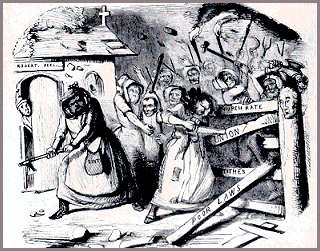
 in progress involves events in and around West Wales in the 1840s. Specifically, that area of Wales where the three old counties of Cardiganshire, Carmarthenshire and Pembrokeshire meet, in the summer of 1843 when the Rebecca Riots – nocturnal gatherings of men dressed as women for the purposes of destroying tollgates and addressing other perceived social ills – were in full swing.
One of the things the characters are having to grapple with at the moment is whether folk history/oral history is as valid as the written down variety.
In my research I came across this lovely quotation from Gore Vidal
‘Since I have been written about, perhaps, a bit more than most historians, I am not as impressed as they are by what I see in print, no matter how old and yellow the cutting.’
Yes, quite. I think I’ve mentioned here before that things look far more official when in print so I would have to agree with Mr Vidal. But why is this? The phenomenon of the apparent trustworthiness of print, I mean, not my agreement with GV. Is it a hang-over from the time when simply to be able to write things down meant that one was educated and therefore entitled to speak with authority? Or do we generally find the things we believe in print to be mostly true and therefore believe it all on balance?
I’ve had the odd brush with the press myself in a previous life (more of that at some future date, maybe) and know, to my cost, that what is written is not always objective or truthful. The story is all and facts take second place. But is oral history – interviewing people who took part in events – or fok history – the stories which have come down to us by word-of-mouth about those events - any better?
It seems to me that cold, hard, literal truth (if such a thing exists) is nearly always pushed into second place by the need to tell an engaging story. Newspapers will alter facts if they think this fits their story better and I’m sure documentary makers do the same. Otherwise the cutting floor would not be littered with dozens of hours of footage and we would be watching very lengthy television programmes.
Folklore may, possibly, do this cutting and colouring less consciously but only those elements which contribute to the thrust of the story will be left in, details which go against the grain will, either from the beginning or over time, be winnowed out. I guess that’s why folk tales from the same country can look quite different in separate regions as the tellers have adapted the tale to their own local agenda.
Inevitably, I’
 m doing the same in my book. Obviously, I have a particular view of what it must have been like to participate in the Rebecca Riots and I am, in all probability, ignoring facts which don’t chime in with that. At the very least, I will be chosing to tell those bits of the story of the riots which fit in with my views and the way my characters perceive events. If I had no view, it would be an indication that I have absolutely no interest in the events and there would be no point in spending all this time writing a book about it.
Some people might say that that makes my book – possibly all historical fiction – a less valid enterprise than writing a textbook. But, aside from the fact that the motivation for writing a novel is very different from that which inspires non-fiction, haven't we all read historical fiction which has catapulted us lock, stock and barrel into a different time period, immersed us totally in the way of life and ways of thinking of the time in a way which a non-fiction book, however brilliant, never could . As I write, I’m thinking of Lindsey Davis’s books starring Roman 'private informer' (and sometime spy) Marcus Didius Falco. I’m fascinated by the Romans and have read numerous books about them but none brought them to life and made me feel that I knew how they ticked like Falco’s exploits. You can hear, see, taste, touch ancient Rome. And, what’s more, it’s quite clear from Lindsey Davis’s take on the Romans that human nature doesn’t change. Or, at least, Lindsey Davis doesn’t think it does!
Fiction isn’t just about facts (the clue’s in the word, folks) it’s about how people interact with the events they are caught up in, how they feel about them, how they perceive them, how they remember them, how those events change their lives. And, I’m assuming, that’s what folklore represents. Not just what happened but how what happened shaped the people to whom it happened.
The debate between narrative history and ‘respectable’ history is not academic in the book I’m working on. Which side wins the argument will determine how the book proceeds, whether a dream flourishes or dies, but it’s been interesting to think about the whole issue and to come to the conclusion that, whichever version you prefer, all history is story, whether we recognise it as such or not.


